2024

DBI—2333910: Lions and tiger sharks, and hares…oh my! Stabilizing and providing digital access to eight decades of parasites from vertebrates. $696,447 awarded in 2024 to Drs. Janine Caira, Katrina Menard & Bernard Goffinet.
Team member: Dr. Veronica Bueno (Parasitologist and Curatorial Postdoc).
Overview
This project focuses on nine historical collections of vertebrate metazoan parasites donated to UConn’s Department of Ecology & Evolutionary Biology’s Biodiversity Research Collection facility over the past two decades. These collections are the result of 80 years of fieldwork by expert parasitologists and students. The collections comprise 113,800 microscope slides, 13,850 vials, and 528 jars of fluid-preserved specimens complemented by 10,479 necropsy sheets and cards detailing host specimen data. Hosts include at least 716 species in 430 genera representing 74 vertebrate orders. The three most speciose phyla of vertebrate parasites (i.e., Platyhelminthes, Arthropoda, and Nematoda) are represented. We have focused our immediate efforts on stabilization and curation, which has revealed the scope of curatorial work needed to showcase these unique collections. Over 3,500 slides need remounting, 3,200 slides need their labels to be re-attached, and 9,520 vials must be replaced with archival vials and lids. We also now recognize the magnitude of manpower required to properly accession and digitize the approximately 128,000 specimens and containers. We are seeking funds to complete these tasks. The full curation of these unique collections and dissemination of all their data publicly through the Lawrence R. Penner Parasitology portal, iDigBio, and GBIF, will make it possible for these irreplaceable collections to achieve their full potential as a resource for discovering novelty and exploring a wide array of questions about the ecology and evolution of vertebrate parasites.
Intellectual Merit
The hosts of these parasites span the vertebrate tree of life, and most would be difficult or nearly impossible to sample for parasites today. For example, many are now protected under CITES or IUCN Red List regulations. A large proportion of the parasites are unidentified, and many come from host taxa that have rarely or never been examined, thus the potential for novelty is high. Highlights include parasites from teleosts in the deep-water canyons off the western Atlantic Ocean, digeneans from bats of eastern Africa, parasites collected from teleosts in fish markets of San Francisco annually over a period of 40 years, and what is arguably the most comprehensive collection of parasites from the vertebrates of New England. The breadth of parasite taxa makes these collections an unparalleled and irreplaceable source of data for advancing our understanding of patterns and processes of coevolution. Their historical nature makes them especially valuable as a source of data for exploring changes in parasite faunas over time. The expert parasitologists who assembled these collections intuitively embraced the concept of the “extended specimen” decades ago. As a result, the six largest of the nine collections have extensive and extremely fine-grained associated host data, making them also invaluable resources for addressing a variety of fundamental ecological questions about parasite communities at multiple levels. With the assistance of UConn’s Information Technology Services, we will modify the existing LRP database to include a host necropsy data module and to share data with iDigBio and GBIF, providing access to these collections and their associated data to researchers throughout the globe.
Broader Impacts
Digitization and sharing data on-line will facilitate access to these nine collections, as well as data for the 5,900+ specimens (40% paratypes; 20% molecular vouchers) already in the LRP by the broader scientific community. One Curatorial Postdoctoral Fellow, six BS/MS, and 22 undergraduate students will receive training. The Connecticut State Parasite Initiative, which will take the form of a competition, is aimed at enlightening middle school students about the diversity and marvelous biology of parasites and the value of the museum collections to the discovery and study of the biology of these animals. In collaboration with the Connecticut State Museum of Natural History, an online resource will be created to provide information on 25 iconic Connecticut vertebrate species, and four of their parasites, each represented by specimens in the focus collections. Classes of middle school students will be challenged to select a parasite of interest and make a case for their species to be designated as Connecticut’s State Parasite. The most convincing case will be determined through a two-phase selection process, ending in a widely publicized public vote to draw attention to the initiative. Students will learn about the legislative process required to transform an idea to a Bill and finally to a Law, if such a designation is to be achieved, through a virtual conversation with a Political Scientist and a Connecticut State Legislator.
2022
DBI—2217280: Digitization TCN: iDigBees network, towards complete digitization of US bee collections to promote ecological and evolutionary research in a keystone clade. $47,288 awarded in 2022 to Dr. Katrina Menard. See also the iDigbio page.
Proposal abstract reads:
Bees are the most important pollinators in both managed and natural landscapes, and concerns are quickly growing about declines in bee diversity and numbers. Only a fraction of the ca. 4,000 known bee species in the United States have adequate data for assessing their presence or absence in an ecosystem. The iDigBees Thematic Collections Network addresses this problem by transcribing specimen label information for thousands of bee specimens in US insect collections into a shared global database. As a result, bees will become the first major insect group to have specimen data sufficiently digitized to promote research projects and support conservation efforts. Specifically, the iDigBees project will (1) map distributions for thousands of bee species and quantify patterns of bee biodiversity; (2) identify data gaps to inform future inventory and monitoring efforts; (3) reveal changes in species distributions over time through historic records; (4) document the impacts of a changing climate on bees; (5) identify critical taxa and geographic areas for conservation; and (6) establish a network of researchers, conservationists, and land managers to rapidly utilize data for research, education, public policy, and land management. The education program will coordinate an array of existing programs and create a new technology-mediated learning tool, SMARTBees, to serve high school and college students. Obtaining specimen-level data on US bee species and communities, and integrating findings into education programs, are essential steps toward addressing the pollinator crisis.
iDigBees represents an in-depth insect biodiversity digitization initiative that will mobilize at least 350,000 bee specimen records, and 6,600 high-resolution image suites. Obtaining specimen-level data on US bee species and communities is an essential step toward addressing the pollinator crisis. Via the novel networks proposed here, species distribution patterns and “extended specimen” data will emerge, leading to testable hypotheses as to underlying mechanisms and predictions on how bees will respond to future global changes. Integrated data will also shed light on how particular life-history traits life-history traits respond to environmental change. iDigBees will help to highlight candidate pollinator restoration options for agricultural, urban, and other managed landscapes. This project, in partnership with researchers and government agencies, will provide open-source datasets for policy, research, and education. The iDigBees model will be promoted throughout North America and other continents to foster “deep global digitization”. The iDigBees network integrates educational and public engagement initiatives to work with the Biodiversity Literacy in Undergraduate Education (BLUE) RCN to build and implement novel biodiversity data-centric Open Education Resources that promote student-oriented learning. SMARTBees will serve as a digital platform featuring learning modules designed to serve culturally diverse high school students who are transitioning into community college as well as first year undergraduates. Building on the extended specimen model exemplary digital bee specimens will teach students host plant relationships, key evolutionary concepts and the important role pollinators have in sustaining the biodiversity of our planet.
2016
DBI-1561640 — CSBR: Ownership Transfer: Securing the future and accessibility of the Carl W. and Marian E. Rettenmeyer army ant guest collection. $499,850 awarded in 2016 to Drs. J.N. Caira, J. O’Donnell & B. Goffinet.
Overview
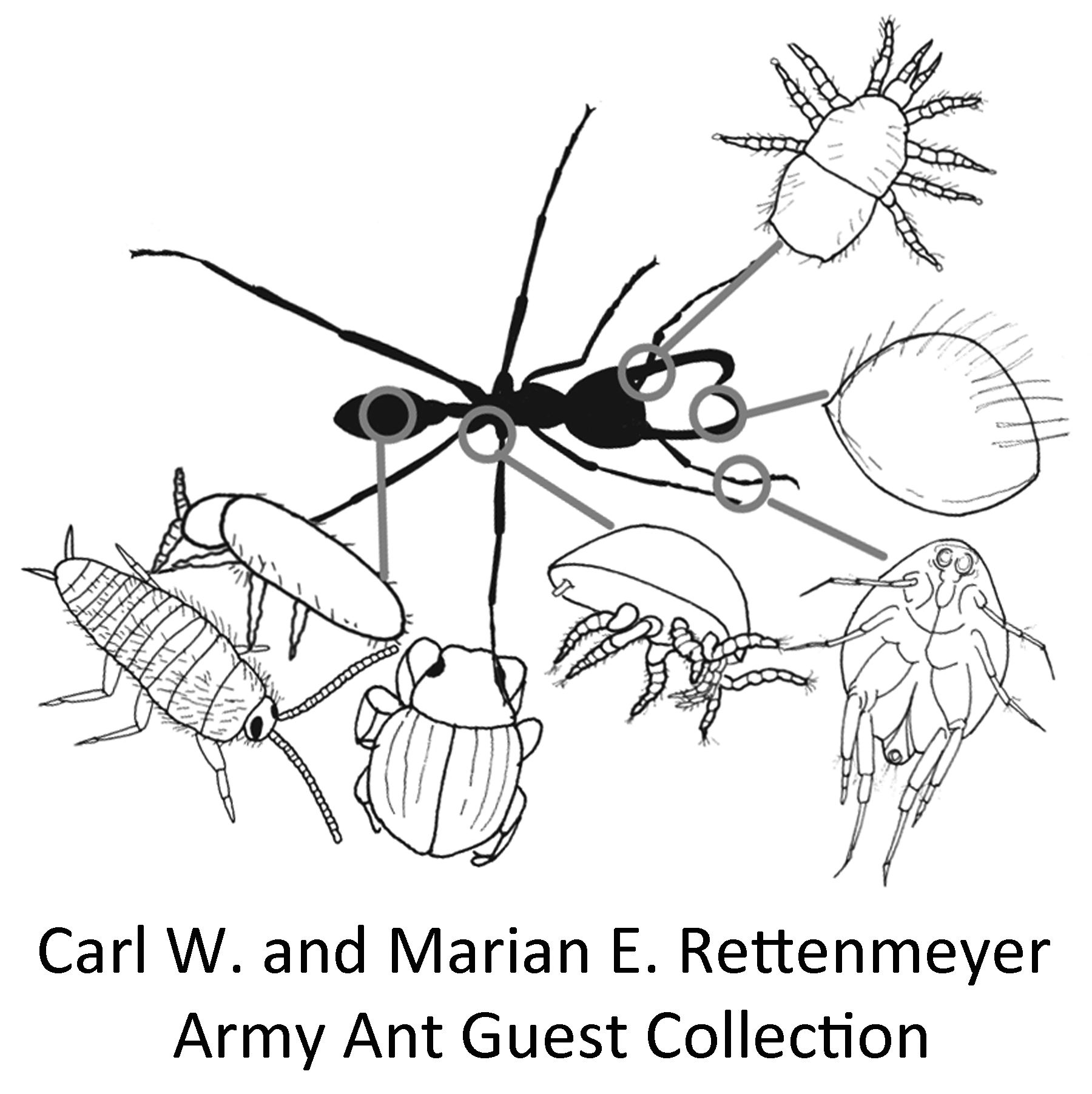
The motivation for this project comes from the recent donation of the Carl W. and Marian E. Rettenmeyer Army Ant Guest Collection (AAGC) to UConn and its transfer to the Department of Ecology & Evolutionary Biology’s state-of-the-art Biodiversity Research Collection Facility (BRCF). This amazing collection is the result of over 50 years of fieldwork by the Rettenmeyers in Central and South America. The AAGC comprises ∼2 million specimens of New World army ants, representing 114 species, and 1,200 colonies, as well as ∼100,000 specimens of a spectacular diversity of their myrmecophile guests. The guests include hundreds of species of mites, beetles, flies, wasps, springtails, and bristletails. The AAGC also contains ∼1,000 type specimens of 200 species. There are ∼16,000 pinned specimens and ∼5,000 microscope slides, but the majority of specimens are preserved in ∼15,000 vials and 200 jars. The collection is complemented by extensive and detailed field data and 5,000 Kodachrome slides. The urgency of this request stems from the collection being currently unusable and in urgent need of stabilization—fluid levels are low, stoppers are deteriorating, containers are non archival, specimens are overcrowded, some slides need sealing, and specimens are not organized for easy retrieval. The opportunity to benefit from Marian Rettenmeyer’s knowledge is vanishing. With the assistance of an experienced team of UConn programmers, the AAGC would, through this project, realize its full potential as a valuable on-line resource for the study of complex host/symbiont systems. Perhaps most importantly, this project will ensure a secure future for the AAGC.
Intellectual Merit
The collection is significant from several standpoints. Many specimens are authoritatively identified and serve as a taxonomic resource for host and guest identification confirmation. Many others are unidentified and likely represent novel taxa. Furthermore, extensive holdings preserved in ethanol or on pins are valuable sources of DNA. The AAGC includes empirical compilations of natural history data for multiple replicates of complex symbiotic systems. The project’s two primary goals are curating specimens and establishing an on-line presence. Specimen curation will consist of stabilization (replacing fluid, re-vialing, ringing coverslips, etc.), labeling, reorganization, attaching barcodes, and mounting exemplars of army ant colonies. With the assistance of UConn’s Information Technology Services, we will modify an existing MySQL host/parasite database (DB) to accommodate the AAGC in four related Tables (Colony, Specimen, Field Card, and Kodachrome Slide). Imaging will focus on type specimens, colony exemplars, field cards, and Kodachrome slides, which will be linked to appropriate DB records. We anticipate georeferencing the limited number of localities in the AAGC with minimum uncertainty using Google Earth. The DB will be fully iDigBio compatible; we will use GBIF’s Integrated Publishing Toolkit and its built-in RSS feed generator to export data to iDigBio as updates occur.
Broader Impacts
The on-line DB and its integration with iDigBio will facilitate access to this unique resource by the broader scientific community (expert taxonomists, ecologists and evolutionary biologists). A two-part exhibit, developed in collaboration with the Connecticut State Museum of Natural History (CSMNH), will engage visitors in the wonders of the collection through specimen-based interactive activities. The CSMNH will house an exhibit highlighting the Rettenmeyers’ collecting activities and describing the genesis of their collection. Across campus, in the lobby of the BRCF building, a giant ant model, complete with guest mites to-scale, will lure visitors and students to an exhibit case detailing the significance of, and diversity in, the AAGC. Large ants installed on the outside of both buildings will foster intrigue about the collection. We plan to assemble “Kodacrews” of high school students to work with a graduate student to hone their writing and observation skills. These students will populate the Kodachrome Slide Table with data from slide labels and observations on image content.
Team members:
Dr. Geert Goemans (Entomologist and Curatorial Postdoc) and Elizabeth Barbeau (Program Assistant and Database Manager).
I participate in all aspects of the project, including training and supervising students; transferring, labeling, sorting and identifying specimens; interpreting, verifying and entering data; and establishing work-flows. I contribute to outreach activities stemming from the project’s AntU initiative, oversee the project’s social media elements, and assist with exhibit development.
As the Program Assistant and Database Manager for the AAGC my primary role is to coordinate the development and population of our homegrown collection database, which will ultimately host all of the Rettenmeyers’ army ant and guest specimens as well as supplemental visual and archival material. I make and implement decisions on digitization strategies, data migration, and metadata extraction in order to create original catalog records for all collection objects, facilitating information retrieval and intellectual access to special collections material online. This process involves compiling and standardizing data according to Darwin Core specifications (for future sharing to iDigBio), scanning physical objects, and entering data into the database. I also support the outreach aspects of the AntU initiative through the UConn Army Ant Guest Collection Facebook page, in addition to participating in our many interdisciplinary projects with students and faculty across campus.
2009
DBI-0847111 — Completing a virtual herbarium at the University of Connecticut. $476,020 awarded in 2009 to Drs. D. Les & R. Capers.
Overview
The George Safford Torrey Herbarium at the University of Connecticut proposes to complete work on its virtual herbarium, databasing all remaining vascular plant specimens and imaging all specimens. All specimen data are made available online already, and images will be as well. The herbarium collection is of regional importance and may represent the most comprehensive collection of plants in southern New England. The collections of several important early botanists are housed in the herbarium, dating to the earliest part of the 19th century, making the specimens particularly valuable for study of changes in phenology and community composition resulting from alterations of the landscape or climate caused by human activity.
Intellectual merit
Complete data on the entire 200,000-specimen herbarium were entered into the relational database BG-BASE. In addition, each of the 200,000 specimens were imaged at high-resolution. All data and images were made freely available through the BRCF website (bgbaseserver.eeb.uconn.edu/database.html) and other data aggregators (e.g., the Consortium of Northeast Herbaria, the Royal Botanic Garden in Edinburgh, iDigBio, and the Global Biodiversity Information Facility). Computing and imaging capacity was greatly increased in the BRCF. Activity involving BRCF plant materials both regionally and internationally increased substantially. As examples, specimens identified only to family were identified to species by expert taxonomists examining images on-line.
Broader Impacts
More than 50 undergraduate students were trained in the use of a sophisticated relational database. In addition, lesson plans were developed in conjunction with Connecticut high school teachers so that searchable, mapable specimen data could be downloaded and used in high school lab exercises. These lesson plans were also made available on-line via the BRCF website and were described in a publication directly resulting from the award (Capers & Les, 2010).
Capers, R. S. and D. H. Les. 2010. Web site promotes plan data as a novel educational resource. Connecticut Journal of Science Education 47: 35–38.
1999
DBI-9876793 — Biological Research Collections: A new combined collection facility for the University of Connecticut systematic research collections. $440,876 awarded in 1999 to Drs. J. N. Caira, D. Les, K. Schwenk & D. Wagner.
Introduction:
Over the course of the last century, the University of Connecticut has developed significant collections of mammals, birds, fishes, insects, ant guests, parasites, contemporary plants, and fossil plants. In 1999 we received an award to assist with the relocation of these systematic research collections from five locations across the campus of the University of Connecticut to a new combined collection facility in a new biology building. Despite a brief pause in construction owing to problems with the general contractor, the building and facility were completed in January of 2002. We are pleased to report that we were able to achieve all of the original goals of the project. In addition, the Dean of the College of Liberal Arts & Sciences provided funds for additional equipment purchases, allowing us to exceed our original plans. An unanticipated award from the International Water Lily and Water Gardening Society supported the purchase of a new botanical database and the transfer of records from our existing database to this new platform. The facility opened formally in December of 2003 with a gala event, featuring a talk by Dr. Peter Raven and attended by more than 150 people.
The project was conducted in three phases. The pre-move phase involved limited essential curation, and the sorting, wrapping, and boxing or packing of specimens and 705 linear feet of collection-associated library materials (books, reprints, field notes, etc.). Treatment of fluid-preserved materials: Glass jars containing fluid-preserved vertebrates (3,230 lots of fish, 200 lots of mammals, and 559 lots of birds, in total representing over 110,000 specimens) were topped off with ethanol. Cracked or inadequate lids and jars were replaced. Jars were wrapped in bubble-wrap and boxed. Approximately 24,000 vials containing fluid-preserved insects, other arthropods, and molluscs were topped off with ethanol and fitted with new stoppers as required. Approximately 4,600 of the 7,000 vials from the Penner collection containing fluid-preserved helminths, primarily of birds and mammals, were transferred to new vials with new stoppers. All vials were transferred from old wooden vial racks and metal drawers to new divided paper unit trays. The trays were securely packed in bubble-wrap and boxed. A donation of 5,000 vials and 600 jars of fluid-preserved elasmobranch tapeworms was received from R. Campbell. The specimens in jars were transferred to new jars and moved to the spirit room in the new facility along with the vials. Treatment of dry materials requiring boxing: 4,000 boxes of mammal skulls and skeletons, 1,000 bird skulls and skeletons, 400 lots of feathers, and 3,000 lots of bird eggs, were packed in boxes. All 378 bird nests were wrapped in acid-free tissue paper and re-boxed. These boxes were subsequently wrapped in bubble-wrap and packed. Approximately 34,600 unmounted vascular plant, bryophyte, and lichen and non-lichen forming fungi were boxed. Approximately 85,000 microscope slides of helminths and arthropod parasites, primarily of mammals and birds, were transferred from deteriorating wooden slide boxes to new plastic slide boxes, color-coded by major parasite group. The protocol followed for the 8,030 paleobotanical specimens differed from that followed for the other collections. These specimens had no accession numbers prior to the move, and the data associated with them were located on the wooden drawers in which they were originally housed. Thus, these specimens were given accession numbers and preliminarily databased as part of the pre-move project activities.
Movement of collections to the new facility involved an aggressive pest management program for all but the fluid-preserved specimens, microscope slides, and paleobotanical specimens. Specimens were treated for one week at -20°F in a rented freezer container (8’x 8’x 40’). This aspect of the project was streamlined significantly when we determined that many specimens could be packed and frozen in their original drawers and/or, slightly modified old cabinetry. Thus, 140,000 herbarium sheets of vascular plants and bryophytes were transferred to half-height herbarium cabinets mounted on dollies and frozen. Likewise 10,500 bird study skins and 25,300 mammal study skins were transferred in their original drawers to cabinets mounted on dollies and frozen. Approximately 1,000 Cornell drawers of insects and ant guests were loaded onto metal (railed) carts, wrapped in plastic, and frozen on these carts. This method significantly reduced the need to purchase and pack boxes, and shortened the period of freezer container rental from 6 to 5 months. Immediately following each round of freezing, cabinets were wheeled into the new facility. All collection-associated library materials were also boxed and frozen. All specimens not requiring treatment for pests were moved directly into the facility once it was open.
In order to streamline use of the rented freezer container, specimens that had been frozen were integrated into the new facility in two stages. They were initially transferred into new drawers and cabinets in their original unit trays and arrangement, i.e., drawer for drawer. All mammal and bird study skins were subsequently transferred from the old non-archival unit trays and expanded and reorganized into drawers lined with acid-free paper. The mammals were reorganized based on Wilson and Reeder (1993) and the birds were reorganized based on the AOU checklist (1998, 2000, 2002, 2003) for North America and Clements (2000) for the rest of the world. Unfortunately, we underestimated the number of skull boxes requiring replacement as a result of water damage incurred in the previous facility. Thus, following freezing the skulls were moved to shelving in the new facility, but now await new boxes and reorganization. The purchase of 1,300 new Cornell drawers paved the way for the expansion of the insect collection to alleviate significant overcrowding in existing Cornell drawers. The existing Cornell drawers were arranged in phylogenetic order in the new facility, and the new Cornell drawers were interspersed among them. Expansion of the existing drawers of insects into new drawers was completed for approximately 30% of the collection. Approximately two-thirds of 400 lots of bird feathers were transferred to archival zippered plastic bags. The 140,000 sheets of herbarium specimens were expanded and arranged alphabetically by family. Approximately 2,000 bryophyte and lichen specimens were transferred to new genus covers, color-coded by geographic locality of origin. The paleobotanical specimens were transferred into new drawers lined with acid-free paper on top of ethafoam. This collection awaits additional curation, reorganization, and expansion. All fluid-preserved specimens were unboxed and transferred directly onto designated areas of shelving in the new spirit room.
Complete databasing of the collections was beyond the scope of the project; however, we were able to achieve both of the major databasing goals of the plan. The platforms and formats of the databases were finalized, and we were able to make significant progress with the population of the databases for all collections. We chose BG-BASE as the database platform for the contemporary plants. The software was acquired with the assistance of a donation from the International Water Lily and Water Gardening Society made specifically for this purchase. The ~30,000 contemporary plant records in our existing less versatile database, were migrated to BG-BASE, and an additional ~20,000 vascular plant and bryophyte records were entered into BG-BASE over the course of the project. In addition, 26,000 of the records, mainly New England specimens, were geo-referenced and all 237 type specimens of contemporary plants were imaged. We chose FileMaker Pro as the database platform for the remaining seven collections. Individualized databases, tailored to accommodate taxon-specific information, were created for each collection. In general, databasing was done directly from specimens, as we determined early in the project that the written catalogues inaccurately reflected holdings. Approximately 5,000 bird study skins (~50% of specimens) and the 378 bird’s nests were databased, as were 769 mammal study skins (~3% of specimens). The insect database was transferred from Excel to FileMaker Pro and now includes records of 3,000 species representing over 47,000 pinned specimens (~25% of specimens). The ~24,000 vials of fluid-preserved insects and other invertebrates were databased. An inventory of ~4,600 vials of fluid-preserved helminths in the Penner collection, which are currently associated only by the original collection code, was created in Excel as part of the pre-move activities. This inventory will be databased at a time when the associated data can be extracted from host cards and correlated with the collection codes. As noted above, the 8,030 paleobotanical specimens were databased in a preliminary fashion to allow them to be moved; they await more detailed databasing. In total, 50,769 specimens were databased over the period of the award. A website for the collection facility and its associated web pages was developed to accommodate the new databases. Currently, 6 of the 8 databases can be accessed via this website. This site now also includes a “clickable” plan of the new facility with images of its components.
Personnel:
Over the course of the project 26 individuals were supported fully, or in part, with funds from the grant. These included 2 high school students, 8 undergraduate students, 7 graduate students, 5 curatorial assistants and 4 consultants. The high school students and undergraduates assisted with many of the pre-move activities including transfer of specimens to new containers (jars or vials), topping off alcohol in fluid collections, wrapping and boxing of specimens, numbering fossil plant specimens, and transfer of microscope slides from wooden to archival plastic slide boxes. They also contributed significantly to databasing activities in all of the collections. The graduate students were primarily involved with post-move activities. They designed and implemented the FileMaker Pro databases and collections website, and expanded and curated portions of the insect and parasite collections. They also contributed significantly to the databasing activities of the project. The curatorial assistants supported on the grant targeted vertebrates, so as to provide expertise that complemented that of our current invertebrate and botanical curators. These individuals were responsible for the reorganization, expansion and curation of the bird and mammal specimens. They too contributed significantly to the databasing activities in these collections. Each consultant was hired to travel to UConn for a period of 4 to 7 days to provide advice on specific issues. Tom LaBedz, vertebrate collections manager of the University of Nebraska, developed a detailed plan for the freezing and move of the vertebrates. Pat Gensel, Professor of Paleobotany at the University of North Carolina Chapel Hill, assisted with the accessioning, labeling, and organization of the paleobotany collection. Kerry Walter, Director of BG-BASE Europe, assisted with the migration of data from our existing herbarium database to the new database. Martin Pullen developed Perl scripts for database queries. In addition, Dr. Jane O’Donnell, who was a half-time employee in the facility at the beginning of the award, was increased to full-time, with half-time support from the grant for the first two years of the award, on the condition that she be employed by the University permanently on a full-time basis thereafter. She is now a permanent, full-time employee of the University.
Equipment purchased in combination with award and matching funds allowed us to equip the facility fully and includes: a Crown powerlift (work assist vehicle) to access the upper ranges of the 10 ft high cabinets, an ultra-cold freezer 25 ft3 , 1,300 Cornell drawers, 3M MP8749 portable LCD projector, three Dell Optiplex GX260s computers, two PowerPC G4 Macintosh computers and a Macintosh powerbook computer for databasing in the spirit room, a Macintosh Airport Extreme Base Station, an HP Laserjet 5100 printer, an HP Officejet 7110 color printer/fax/scanner/copier, an EPSON Expression 1640XL flatbed scanner, three Wasp barcode readers, a Speedotron A50 strobe kit, a Nikon D100 digital camera and Bencher copy stand and Balcar Light Pyramid 71, an Automontage imaging system with IBM IntelliStation M Pro computer, a Leica MZ16 stereomicroscope with drawing tube and 1X and 0.5X objectives, a Schott Fostec DCR III illuminator, an Olympus UCA compound microscope with Nomarski optics, and a JVC 3 chip digital camera, a Cannon PC 940 photocopier, a Kenmore refrigerator, a Lane Scientific Plant Drier Cabinet, four steel storage cabinets, a map cabinet, and a Dicksonware temperature and humidity datalogger. Software purchased includes: three copies of Filemaker Pro 6 (Macintosh), two copies of Timbuktu 5.1, and four copies of Adobe Photoshop 7 (two for Macintosh & two for Windows).
Broader impact:
This new state-of-the-art collection facility at the University of Connecticut has already been able to serve the curatorial needs of several other institutions. Over the period of this award several institutions and individuals throughout New England approached us about the possibility of accepting orphaned or languishing collections. We have accepted or agreed to accept: botanical collections from Dartmouth University (a large portion of the former Jesup herbarium) and the University of Massachusetts-Amherst (recent collections from Latin America), the Rhode Island Odonate Atlas voucher collection, the Vermont Butterfly Survey voucher collection, and the parasitology collection of R. Campbell. The most dramatic impact has been the increase in the number of visitors. The number of visitors in the 6 months since the facility formally opened, has already exceeded the number of visitors to the collections over the last 5 years combined.