Army Ant Guest Collection (AAGC) Database

Colony Module
The Colony Code tells users what kind of colony they are viewing and distinguishes army ant colonies from prey colonies and wasp nests.
E = Originally intended to describe “Eciton” colonies, these are army ant colonies first identified by Carl Rettemeyer over the course of his 50+ years of collecting in the Americas.
D = These army ant colonies were collected and tracked by the many collaborators Carl Rettenmeyer worked with over the decades.
F = Although they include species in the Formicidae, these colonies represent prey colonies tracked by Carl Rettenmeyer.
V = Originally intended to describe “Vespidae” nests, these include various families of wasps identified primarily as part of Rettenmeyer’s graduate student Ruth Chadab’s doctoral dissertation [link?]
Much of the colony database was compiled from what we refer to as “colony notebooks” but are actually binders containing tables of data that include colony numbers, dates, field numbers, and very general locations.
Besides E-Colony and V-Colony notebooks, V-colony data was also pulled from tables in Ruth Chadab’s dissertation, and other copies of field notes from other collaborators.
We don’t know exactly how the colony notebook data were compiled. As new information about colonies is discovered on slide labels and from other sources, colony records have been updated accordingly.
Some colony locality data were compiled from historical specimen labels; some names are no longer in use and collections staff has made their best effort to interpret and standardize historic location names. All names that appear in drop down lists for locality fields are the current preferred names. Original country names and locality information has been retained in the “Detailed Locality” field in the Colony and Specimen databases.
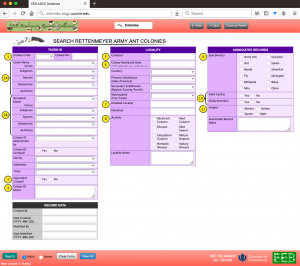
Click for Colony Search Tips
Specimen Module
There are three types of specimen records in the AAGC: Army Ant, Guest and Other.
- Army Ant specimens include individual and lots of specimens containing only army ants. Some army ant samples have been sorted by Rettenmeyer et al, but it is assumed that any army ant sample in the collection may contain guests.
- Guest specimens are samples associated with army ants (e.g., symbionts, parasites or parasitoids, prey, commensals, or “guests of guests”). Guest specimens may include examples of their army ant host (see “Mixed Lots” in the Search Tips section).
- Other specimens include any samples not associated with army ants, or those samples that were collected ad hoc.
Most information in the database has been transcribed verbatim from labels, unless otherwise indicated. When information has been interpreted or corrected (e.g., de-coded abbreviations, historical or municipal locality names, etc), the original text is retained and corrected text is enclosed in brackets. When data is difficult or impossible to interpret, it is documented in quotation marks to the extent possible.
When taxonomic information includes question marks, abbreviations or has been crossed out, only those taxonomic levels that can be determined have been entered in the taxon name fields. The questionable, partial or original ID names are entered in the appropriate note field (Colony Notes for Colony ID information, and Army Ant or Guest ID Notes for Specimen ID information).
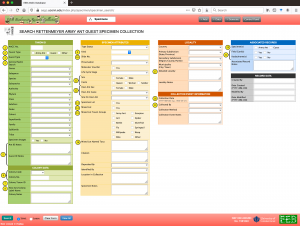
Click for Specimen Search Tips
Field Card Module
Most specimens and collection events represented in the AAGC are described on over 9,500 index cards, known as field cards. These were recorded in the field or transcribed from audiotapes that were recorded in the field. Over time, Rettenmeyer updated these notes with revised taxonomic identifications and numbers of specimens sorted from samples. The Carl Rettenmeyer Papers, held in the UConn Library Archives and Special Collections, contain transcripts of some of these audiotapes and other notes regarding field collections.
Some cards represent multiple field observations/specimen collections (i.e., the same card has multiple specimens or observations recorded on it) and so the same card may be linked to more than one field card record.
All cards have been digitized and all original field cards are retained in the collection.
Each field card may contain many different numbers. The two most obvious are the field numbers and the page numbers.
- Field numbers are primarily recorded on the left side of the card and are associated with an observation or specimen sample.
- Page numbers are always in the top right corner and are used to keep the cards in order.
When viewing records with multiple cards, you can keep the cards in order by referring to these page numbers in the top right corner.
NOTE: Square borders around a field number in the top left corner of a field card appears to indicate that the recorded data does not directly relate to that field number, sample number, or collecting event. When a card could not be unambiguously assigned to a specific Field No. ID, it has been linked to the number noted in the square border to maintain Rettenmeyer’s original order. This ensures that notes about all colonies observed are locatable in the database.
NOTE: See the “What do all these Codes Mean?” section for more information on AAGC codes.
Carl Rettenmeyer worked with a number of researchers over his 50+ years of fieldwork. These researchers assigned field numbers to the specimens they collected for Carl and kept detailed field notes. Their field cards are now held in the BRC with the specimens they describe, have been digitized and added to the database.
Field numbers assigned by other collectors have been given Researcher Codes, to distinguish notes and numbers recorded by Carl from those recorded by others.
The following researchers’ field cards have been digitized and added to the database:
CWR = Carl W. Rettenmeyer
LM = Lois Morales
MER = Marian E. Rettenmeyer
RC = Ruth Chadab
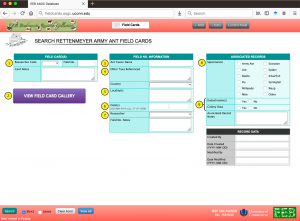
Click for Field Card Search Tips
Kodachrome Module
Over the course of his career Carl Rettenmeyer took thousands of 35mm slide photographs—in addition to hundreds of hours of documentary video footage that would become two documentaries about the biology of army ants and their guests.
The Kodachrome database contains over 6,000 digitized versions of Rettenmeyer’s slide photographs. All slide label metadata has been transcribed but some records do not have images linked, as the collection contains many apparently “duplicate” images. All physical slides are retained in the BRC.
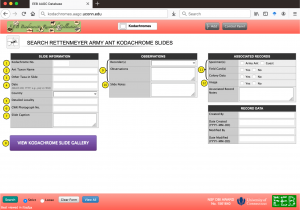
Click for Kodachrome Search Tips
Localities & Coordinates
All content in the AAGC database is licensed under an Attribution-NonCommercial 4.0 International (CC BY-NC 4.0) Creative Commons license

The data and images in these databases can be used for educational, non-commercial purposes with appropriate attribution. Please review the Creative Commons license above for details. Contact the collection curator Dr. Janine Caira with any additional questions.
Please credit the source and photographer for all photographs used. That information can be found in the bottom left corner of each photograph.
Please cite the database as:
UConn Biodiversity Research Collections. 2020. Carl W. & Marian E. Rettenmeyer Army Ant Guest Collection (AAGC). World Wide Web electronic publication. https://aagc.uconn.edu/. Accessed Month XX, 202X.